Is there a future for freelance work? What a new Google DeepMind paper says
You finish a project, send the files, and a thought arrives that was not there a few years ago: could the client have asked an AI instead?
It is a fair question, and most answers you will read are either panic or wishful thinking. A new paper from Google DeepMind is more useful, because it tries to explain how work gets reorganised, not only whether a tool can do a task. It was published on 29 October 2026, and it has something specific to say about freelancers.
What the paper is, and what it is not
The paper is called "Organizing Intelligence". The authors are Alex Imas, Andrew Koh and Shane Legg, all at Google DeepMind. It runs to 108 pages, and a shorter essay, "The Economics of Intelligence", explains the main ideas in plain language.
It is a theoretical model. The authors say clearly that its scenarios are not forecasts and that the views are their own, not Google's. So read it as a way to think, not as a calendar.
Its value is that it starts from a better question than "can AI do my task?" It asks which kind of organisation wins when AI is part of the mix. A freelancer is a one-person organisation, so the question applies to you.
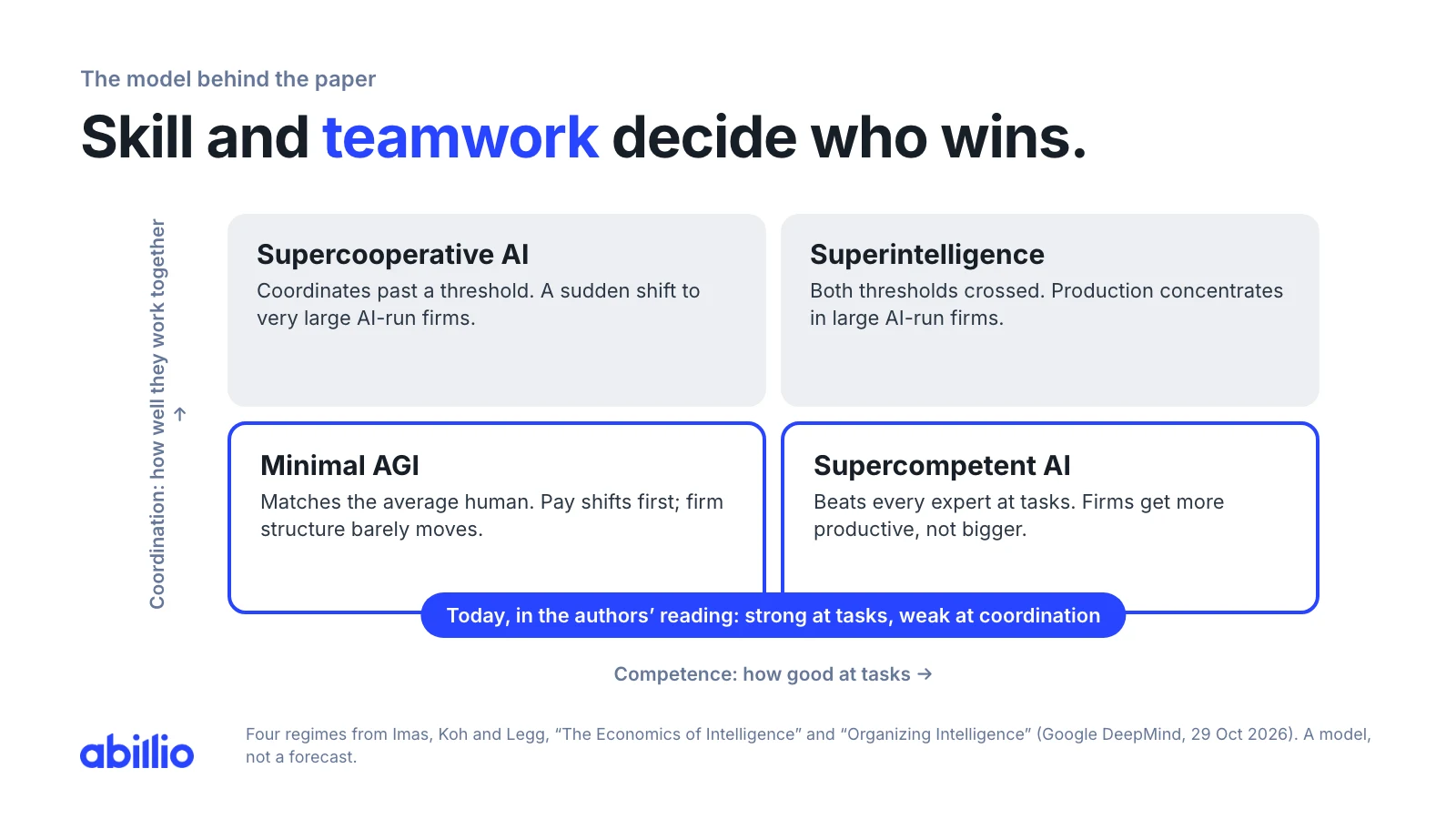
Skill and teamwork are different things
The paper separates two things that usually get blurred together.
Competence is how good someone is at a task: writing, coding, design, analysis. Coordination is how well people, or AI agents, work together as a group grows: sharing context, handing work over, not duplicating effort, catching each other's mistakes. Better competence lifts what a person or team produces. Better coordination decides whether a bigger team keeps getting more productive or starts to slow down.
The authors add that AI differs from people in two ways. Human expertise is scarce, which is why experts earn a premium. AI expertise can be copied at the cost of computing power, so that premium shrinks once a model matches a skill. And unlike earlier machines, AI agents can in principle work directly with each other, without a human firm around them.
Where are we today, in the authors' reading? AI is strong at many tasks and still poor at working together. The paper cites a study of seven popular multi-agent AI systems that failed between 41% and 87% of the time on the tasks tested. The big structural change in the model, a sudden move toward very large AI-run firms, only comes if that coordination problem gets solved.
Why a team of people can beat a smarter AI
Here is the part that matters for anyone who sells skills. People are uneven. One person is excellent at writing and weak at numbers; another is the reverse. The paper calls the result of matching complementary people "mosaic intelligence": a team can be strong everywhere even though nobody on it is.
In the essay, the authors describe a quiz that 100 people took across six domains. Pairs whose strengths complemented each other did 32% better than randomly matched pairs. Copies of the same AI model, by contrast, tend to be weak in the same places, so adding more copies adds capacity but not breadth.
The paper's toy economy makes the point sharply. It includes a coordinator, someone who is weakest on every solo test but makes everyone around them more productive. In the model that person earns more than three times what they would earn working alone, because the value sits in how the team fits together, not in a score on any single task.
Pay moves before jobs do
One of the most useful points in the paper is about timing. In the toy economy, an AI that only matches the average human, nothing more, pushes pay down while everyone stays employed. Specialist pay falls by about 30% and coordinator pay by about 45%, because the AI's cost sets a ceiling on what a scarce skill can charge.
That is an example inside a model, not a prediction. But it explains something people find confusing: headcount can look flat while earnings and job content are already changing. The authors describe today's real economy the same way: leaner start-ups, flatter organisations and little change in total employment. They also cite early, still-debated studies of weaker hiring of young workers in exposed jobs. The latest version of one of them, a Stanford study of payroll data, puts employment of 22-to-25-year-olds in the most AI-exposed occupations about 19% below similarly aged workers in less exposed occupations, while experienced workers show no such gap. Its authors call the findings descriptive, not proof of cause.
Our reading for freelancers: the first sign is less likely to be a lost client and more likely to be pressure on rates or a smaller scope.
What the evidence says about freelancers
The paper is direct here. It says disruption has been most visible on online freelance platforms, where coordination matters least. Two studies it cites show what that looked like early on:
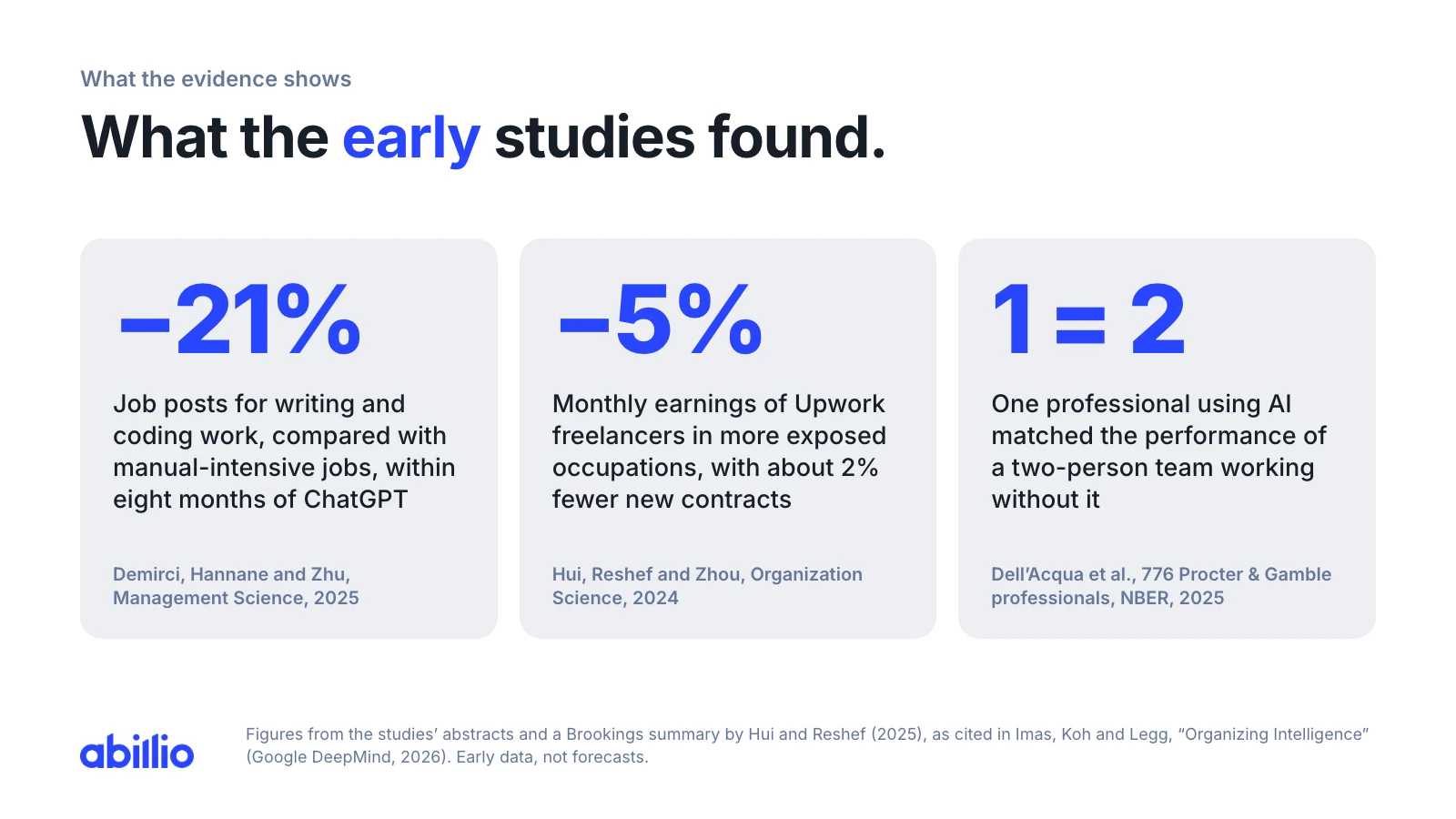
- Fewer jobs, but harder ones. Researchers studying a large global freelancing platform found a 21% fall in job posts for writing and coding work, compared with manual-intensive jobs, within eight months of ChatGPT's launch. The posts that remained were more complex and paid more.
- Lower earnings. On Upwork, freelancers in more exposed occupations saw about 2% fewer new contracts and about 5% lower monthly earnings in the first months after ChatGPT. Freelancers with a stronger track record saw larger declines, so a good record alone did not protect them.
The paper's model explains why: a solo producer selling one bounded task competes head-on with anything that can be copied cheaply, and once the machine's cost falls below theirs, clients switch.
The paper is also careful about what AI still cannot do, and the longer the work, the clearer it gets. In OpenAI's GDPval benchmark across 44 occupations, the best model in the September 2025 release was rated as good as or better than an industry expert on 47.6% of tasks, which OpenAI described as approaching expert quality. Later versions reportedly score higher. In RE-Bench, a test of AI research engineering, the best agents scored four times higher than human experts when both had two hours, but humans scored twice as high as the best agent when both had 32 hours. That study is from 2024, so models have moved on. And on Mercor's APEX-Agents benchmark, 480 multi-step tasks for bankers, consultants and lawyers, the best of eight agents tested scored 24.0% in January 2026.
So the line runs between a task and a project. AI is good at producing a deliverable. It is much weaker, so far, at carrying a piece of work across many steps, keeping the context, and fixing what goes wrong on the way.
There is good news for the individual too. In a field experiment with 776 Procter & Gamble professionals, individuals using AI matched the performance of teams working without it. A freelancer who uses AI well can compete with a small team.
What Anthropic's usage data adds
In March 2026 Anthropic, the company behind Claude, published "Labor market impacts of AI: A new measure and early evidence", by economists Maxim Massenkoff and Peter McCrory. It measures something the DeepMind paper does not: what people actually use AI for at work, not only what it could do in theory.
The gap between the two is large. On theory alone, a language model could help with 94% of tasks in computer and math jobs and 90% in office and admin jobs. In real, work-related Claude usage, it currently covers 33% of tasks in computer and math, the most exposed group. The most covered single occupation is computer programmers, at 75% of their tasks, followed by customer service representatives.
On jobs, the finding fits the rest of this article. Anthropic found no systematic increase in unemployment for highly exposed workers since late 2022. The early signal is in hiring. Among workers aged 22 to 25, the rate of starting a new job in highly exposed occupations is about 14% lower than in 2022, an estimate the researchers call "just barely statistically significant". There is no such drop for workers older than 25.
Charts from this research are going around social media under headlines like "jobs that will be affected by AI in 2027". The report does not say that. It is an early-warning measure, and its authors note that the effects may not show in overall unemployment figures yet.
Our reading for freelancers: exposure is not the same as replacement. It means a client can now do part of the task themselves, which is the same pressure on small, bounded tasks described above.
Four ways to build a practice that lasts
This is our reading of the paper, not the authors' advice.
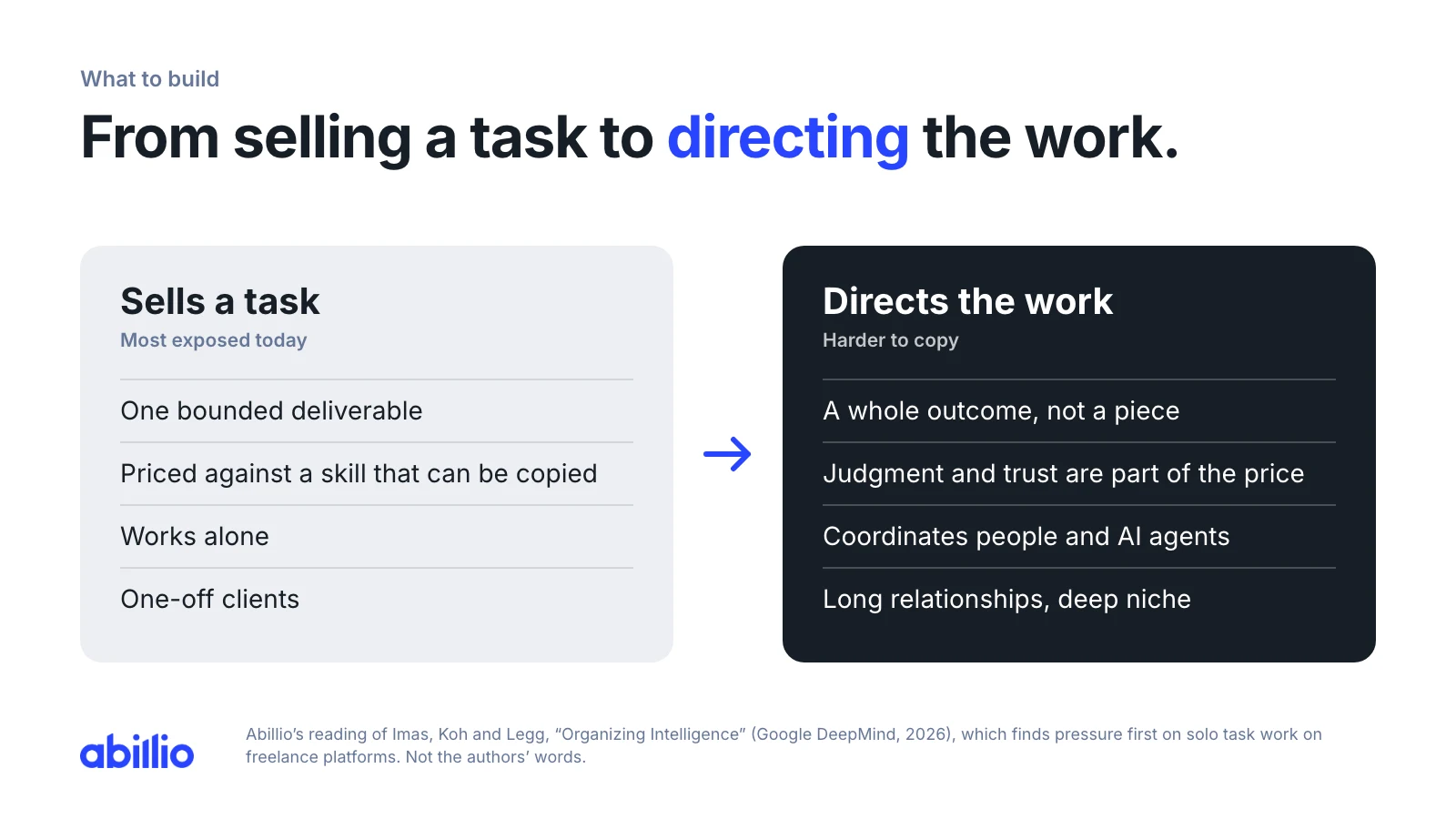
1. Sell outcomes, not tasks. "A logo" or "500 words" is a task. "A brand kit your team can use for a year" or "a content plan that brings in leads" is an outcome. Outcomes need judgment, context and follow-through, which is where the evidence above says AI is weakest.
2. Learn to direct AI like a project lead. Give it a clear role, clear limits and a checklist, then review what comes back. In the paper's model the people who gain are those who coordinate the work, whether the team is people, agents or both. A simple rule that works: the AI drafts, you decide.
3. Go deeper into a niche or a relationship. A good rating is not enough: in the Upwork data above, freelancers with stronger track records saw larger declines. What is harder to copy is a client who buys you, your judgment and your niche, not only the files. A translator who knows a client's legal vocabulary, or a designer who knows the founder's taste, is hard to replace with the next cheaper output.
4. Write down what you know. Your process, your clients' preferences, your templates, your past decisions. Notes you keep in plain files you control are what let any AI tool work the way you work. They are also the part of your practice nobody else can copy.
This weekend's headlines
On Friday 20 November, Levent Alpöge, a mathematician at Anthropic, announced that he and Claude had proved the Riemann hypothesis, a problem open for about 170 years. The proof was released as computer-checked code in the Lean proof assistant. Mathematicians including Andrew Sutherland at MIT and Michael Rubinstein at the University of Waterloo have independently checked that the code compiles and is accepted by Lean.
What is not settled yet: a human-readable proof is still a work in progress, and mathematicians say much work remains to understand the details. Treat it as a major announcement that is still being checked. The same day, a second, human-written claimed proof was posted by a Stanford postdoc; it is a draft and is also being checked.
On 22 November, Meta's chief AI officer Alexandr Wang cited it in an essay, "Superintelligence is Arriving", posted on X. As reported, he argues that what is left between today's models and far more capable ones is no longer raw intelligence but domain know-how, plumbing and experimentation, and that society should not accept a "handover" to AI.
Our reading for freelancers: if the result holds, it is a big jump in competence, the kind of change the DeepMind paper says moves pay and job content first. It says little about whether AI can coordinate and be trusted across a long project, and it needed checking by software and by people. Direction and verification are still human work, for now. And Wang's list, know-how, plumbing and experimentation, is close to our fourth tip: write down what you know.
The forecasts are far apart
The people building and funding AI disagree about what comes next. In an interview with Fox News anchor Bret Baier aired on 7 October, Jeff Bezos said AI-driven productivity could let one income support a family. "Some people will also decide, you know what? I can support my family by working three days a week," he said, and predicted it will become harder to hire people for the same reason. JPMorgan Chase CEO Jamie Dimon told Bloomberg TV in 2023 that today's children will probably work three and a half days a week.
Others expect the opposite. Anthropic CEO Dario Amodei told Axios in 2025 that AI could eliminate half of all entry-level white-collar jobs within one to five years. Ford CEO Jim Farley has said AI will replace half of all white-collar workers in the US. Geoffrey Hinton told the Financial Times he expects massive unemployment and a huge rise in profits.
Both sides expect productivity to rise. They disagree on who keeps the gain: workers, as shorter weeks and better pay, or companies, as fewer staff. For a freelancer the question is more direct, because you set your own price and hours. If a client gets the same result in less of your time, you either charge for the result or lose the hours. That is the first of the four tips above.
A caution
This is a model, not a measurement. So far the effect on jobs overall has been small. A large Danish study the paper cites, covering 25,000 workers in 11 occupations, found no measurable effect of AI chatbots on earnings or hours two years after ChatGPT's launch, ruling out effects larger than 2%. The paper notes that this evidence predates agent tools, and that AI still coordinates poorly. Nobody knows how fast that changes.
The authors point out that a coordination improvement too small to show up on any benchmark could still reorganise whole industries. That is why they suggest tracking real data instead of benchmark scores: how firms split spending between people and computing, and how pay differs across skill profiles.
What we are watching
- Benchmarks that test teams of AI agents, not single models
- Data on how firms split spending between people and computing
- Junior hiring and starting pay in exposed jobs
- Volume and earnings on freelance platforms
At Abillio we work with freelancers every day. More than 17,400 have registered since 2021, and Abillio lets freelancers get paid legally without registering a company. We will keep following this research and sharing what matters for people who work for themselves.
Start at app.abill.io.
Sources
- Organizing Intelligence, working paper by Imas, Koh and Legg, Google DeepMind, 29 Oct 2026 (PDF), also on arXiv 2611.05417
- The Economics of Intelligence, essay by the same authors, DeepMind Institute
Studies cited in the article, checked at their original pages on 22 Nov 2026:
- Demirci, Hannane and Zhu, "Who Is AI Replacing?", Management Science, 2025
- Hui, Reshef and Zhou, Organization Science, 2024; summarised by Hui and Reshef in Brookings, 8 Jul 2025
- Dell'Acqua et al., "The Cybernetic Teammate", NBER Working Paper 33641
- Brynjolfsson, Chandar and Chen, "Canaries in the Coal Mine?", Stanford Digital Economy Lab, August 2026 revision
- Humlum and Vestergaard, "Still Waters, Rapid Currents", NBER Working Paper 33777
- OpenAI, GDPval, 25 Sep 2025
- Wijk et al., RE-Bench
- Vidgen et al., APEX-Agents, Mercor
- Cemri et al., "Why Do Multi-Agent LLM Systems Fail?"
Sources for the weekend's headlines (read 23 Nov 2026):
- Scientific American, 20 Nov 2026, updated 21 Nov
- Michael Rubinstein, University of Waterloo: independent check of the Alpöge–Claude Lean proof
- MLQ.ai report on Alexandr Wang's essay, 23 Nov 2026, which links the essay on X
Sources for the Anthropic research and the forecasts (read 23 Nov 2026):